



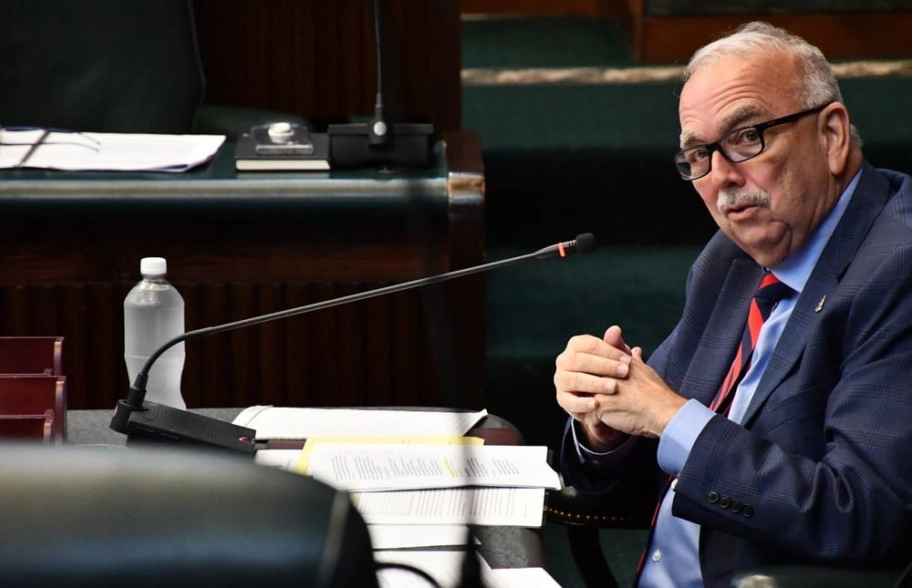
The Standing Public Accounts Committee (PAC) held the first of two public hearings to examine the Office of the Auditor General (OAG)’s Report, “The Government's approach to improving access to affordable housing”, published in August 2026.
The Chairman, Roy McTaggart, opened the session by outlining the report's key findings of 27% population increase between 2019 and 2024, a 42% rise in average rents, and home ownership becoming unaffordable for many Caymanians. The report states that, despite approximately $68 million spent on six affordable homeownership programmes, few homes were delivered, leaving over 1,200 applicants on a waiting list by February 2026. The Auditor General made nine recommendations, all of which the Government accepted. The Committee welcomed the approval of the Public and Affordable Housing Policy and 10-Year Strategic Plan in December 2025, with the hearings aiming to understand limited progress and future implementation.
The Auditor General, Patrick Smith, introduced the report, highlighting that housing costs (including utilities) exceeding 30% of gross income are considered unaffordable according to the United Nations standard, which the Cayman Islands adopted in December 2025. He stated that housing is unaffordable for Caymanians earning the average salary, with average monthly rental costs at 49% of gross income and home ownership being even less accessible.
Mr Smith explained that the report concluded that value for money from programmes offered by Government was limited, largely due to the absence of clear goals, measurable objectives, or performance frameworks. It was noted that the National Housing Development Trust completed only 36 homes (and 50 under construction) despite spending $41 million. The Sister Islands Affordable Housing Development Corporation (SIAHDC) spent $600,000 but delivered no homes during the audit period. Furthermore, the Residential Tenancy Act (2009) remains unenforced, leaving most tenants without modern statutory protection. The Department of Financial Assistance (DFA) provided $23.5 million in rental assistance, with a 67% increase in annual cost and a doubling of recipients aged 65 and over, yet the programme lacks a documented strategy or success measures.
The first witness to present evidence was Deputy Chief Officer (Social Development), Trevor Gibbs, from the Ministry of Social Development and Innovation.
Mr Gibbs explained that DFA determines rental assistance eligibility based on the Financial Assistance Act, assessing applicants' income versus expenses to cover any shortfall. The maximum rental assistance is $3,000 per month, stipulated in regulations for the largest households (nine or more persons). A tiered policy is in place, with a maximum of $1,800 for one to two persons, $2,000 for three to five, $2,500 for six to eight, and $3,000 for nine or more. Mr Gibbs acknowledged that these regulations, based on market assessment at the time, have not been updated for two and a half years and are currently under review. He did not believe the $3,000 maximum was limiting the department's ability to provide adequate assistance.
On the increasing number of elderly recipients of rental assistance, Mr Gibbs confirmed a growing need for senior housing care. He outlined new initiatives, including increased funding for various Non-Governmental Organisations, including the Crisis Centre, Cays Foundation, NCVO, and Acts of Random Kindness, and a pilot programme for emergency housing, currently comprising four units, providing immediate short-term support for vulnerable families.
Mr. Gibbs confirmed that the 2025 Public and Affordable Housing Policy's proposal to move rental assistance to a new Housing Authority is in its early planning stages, with the Ministry ready to implement the legislative transfer when the Authority is established.
Chief Officer for the Ministry of District Administration and Home Affairs, Michael Ebanks, stated that the Ministry and SIAHDC are named as responsible parties in the 10-year strategic plan for affordable housing in the Sister Islands, focusing on land acquisition, housing plan development, and building capacity with the Ministry of Planning. He confirmed that four homes are now 99% complete and nearing handover in early 2027. He accepted the Auditor General's critique as a "roadmap for improvement" and cited recent governance reforms as evidence of progress.
Chief Financial Officer for the Ministry and SIAHD, Nicola Anderson-Wildman, clarified that SIAHDC's expenditure over the past four years has been minimal and self-funded through interest on a time deposit. The Financial Secretary, Kenneth Jefferson, confirmed that the current Government budget shows no additional government injection for the corporation.
Chief Executive Officer for the Cayman Islands Monetary Authority (CIMA), Cindy Scotland, was the Committee's next witness and confirmed that CIMA was not consulted on the 2025 Public and Affordable Housing Policy and 10-Year Strategic Plan, including proposed changes to the Development Bank Act. She stated that CIMA collects quarterly data on deposit loans, weighted interest rates, household mortgages, and non-performing mortgages, sharing this with the Economic and Statistics Office (ESO).
Ms. Scotland clarified that CIMA's role is supervisory, not that of a central bank, meaning that it does not set interest rates. She also noted there are no regulatory requirements for banks to disclose mortgage interest rates, fees, or closing costs, however CIMA does publish common banking fees on its website as part of consumer education. She confirmed CIMA monitors residential mortgage arrears through prudential returns, domestic banking activity reports, and foreclosure reports.
Ms. Scotland concluded her testimony by outlining CIMA's supervisory role over the Cayman Islands Development Bank (CIDB) as per the Development Bank Act 2018, requiring CIDB to comply with CIMA's credit risk measures and AML regulations.
The final witness was the Chairperson for the SIAHDC, Yvette Dilbert, who confirmed that the board charter for Cooperation has been drafted, circulated for review, and is still targeted for adoption by Q4 2026. She also reported that a strategic plan has been drafted, prioritising governance documents (like the board charter) before finalisation.
Ms Dilbert echoed previous concerns that the current affordable housing programme is unaffordable for many Sister Islands residents due to high construction costs and the mismatch between average local salaries (around $3,000 per month) and the income thresholds for applicants (e.g., $5,500 per month for single applicants). She stated that this information has been communicated to policymakers. She further explained that applicants often secure pre-approval but then struggle with additional costs like insurance, making final mortgage approval difficult.
Ms Dilbert reiterated the unique challenges in the Sister Islands, including high import costs for construction materials, transport limitations via barge and the standard government procurement process often resulting in limited contractor bids.
Looking ahead, Ms Dilbert stated that SIAHDC has a work plan to build two more homes in early 2027 on existing parcels, leveraging previous groundwork to expedite construction. Other land parcels require significant preparation (clearing, filling) before development. She expressed gratitude for the Auditor General's report, acknowledging its role in highlighting areas needing improvement and guiding future efforts.
The Chairman concluded the day's session, thanking all witnesses for their candid testimonies, and adjourned the Committee until 10:00 a.m. Thursday, 5 November.