



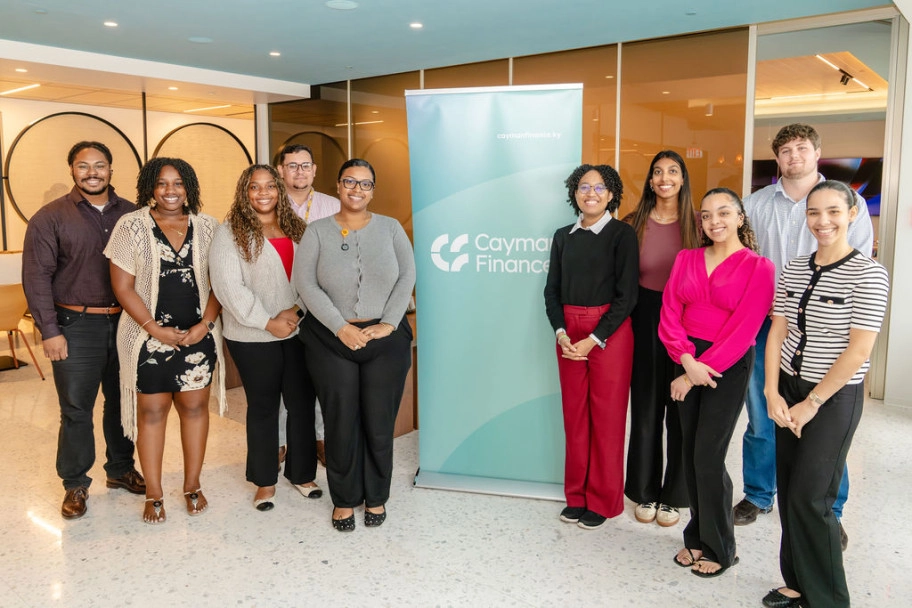
Cayman Finance has opened applications for its 2026 Graduate Training Programme, offering 22 jobs to young Caymanian university graduates seeking to build careers in the financial services industry. The expansion marks a significant milestone for the programme, which started in 2025 with 15 participants.
The programme pairs Caymanian graduates with Cayman Finance member firms, providing each successful applicant with a structured path into the workforce. Participants receive a one-year employment contract at a starting salary of CI$40,000, which research showed was a level attractive to most small and medium firms, whilst in line with the average graduate salary in the UK (£35,000).
The graduates will benefit from a development framework that combines practical workplace experience with dedicated training and mentorship. As part of the training, participants attend a two-day orientation retreat and a 12-week series of weekly professional development workshops. Each graduate is also paired with a dedicated one-on-one independent industry mentor.
The Cayman Finance member firms participating in the Graduate Training Programme this year include Alexandria Bancorp, Alvarez and Marsal, BDO Cayman, Cayman National, Conyers Dill & Pearman, Dentons, DM Financial, Global Captive Management, Grant Thornton, Grant Thornton Specialist Services, Harneys Fiduciary, Highvern, JTC, Leeward Management, Moore Professional Services, Patria Finance, Rawlinson & Hunter, RSM Cayman, Saffery Trust, Teneo, Tenet, and Willis Towers Watson.
The programme is open to Caymanians who have graduated from university in December 2025 or will graduate in 2026. Graduates must apply online and provide proof of being Caymanian as part of the process. The deadline for applications is 30 April 2026. Interested graduates can learn more and apply at: https://caymanfinance.ky/graduate/
Danielle Hennings, Associate Director of Community Engagement at Cayman Finance, said: “The success of the inaugural Graduate Training Programme showed the value of giving Caymanian graduates a structured and supportive pathway into financial services. By continuing the same strong curriculum and support model in 2026 and expanding the programme to 22 jobs, we are creating even more opportunities for young Caymanians to build successful careers, benefit from industry mentors and peer networks, and gain the well-rounded experience needed to thrive in the industry.”
Premier and Minister for Financial Services and Commerce, the Hon. André Ebanks, said: “We recognise Cayman Finance for its leadership in developing this programme, which provides a structured pathway for young Caymanians. We especially commend the participating firms for stepping forward to offer these opportunities and for their strong commitment to investing in the development of local talent. Together, these efforts ensure that our people remain central to the continued success and competitiveness of our financial services industry.”
Minister for Caymanian Employment and Immigration, the Hon. Michael Myles emphasized that the Cayman Finance Graduate Training Programme is a powerful example of how strong corporate citizens can invest in the future of the Cayman Islands. He highlighted that creating structured opportunities for young Caymanians returning from university is critical to ensuring a smooth and meaningful transition into the workforce. By partnering with industry to provide mentorship, training, and real job experience, businesses play a direct role in shaping the next generation of professionals. He noted that initiatives like this not only strengthen individual careers but also build a more sustainable, skilled, and resilient national workforce.
The Graduate Training Programme was created following research into the barriers to creating entry-level jobs for Caymanian graduates. While larger firms were already providing many opportunities, most Cayman Finance member firms are small businesses with fewer than 10 employees. These firms reported challenges such as limited applications, unrealistic salary expectations, difficulty retaining trainees, and the high cost of onboarding and training without dedicated HR support. Smaller firms also found it harder to offer the peer support and broader training environment typically available at larger organisations, so the programme was designed to help address those challenges and make hiring and developing recent graduates more attractive, effective, and cost-efficient.