



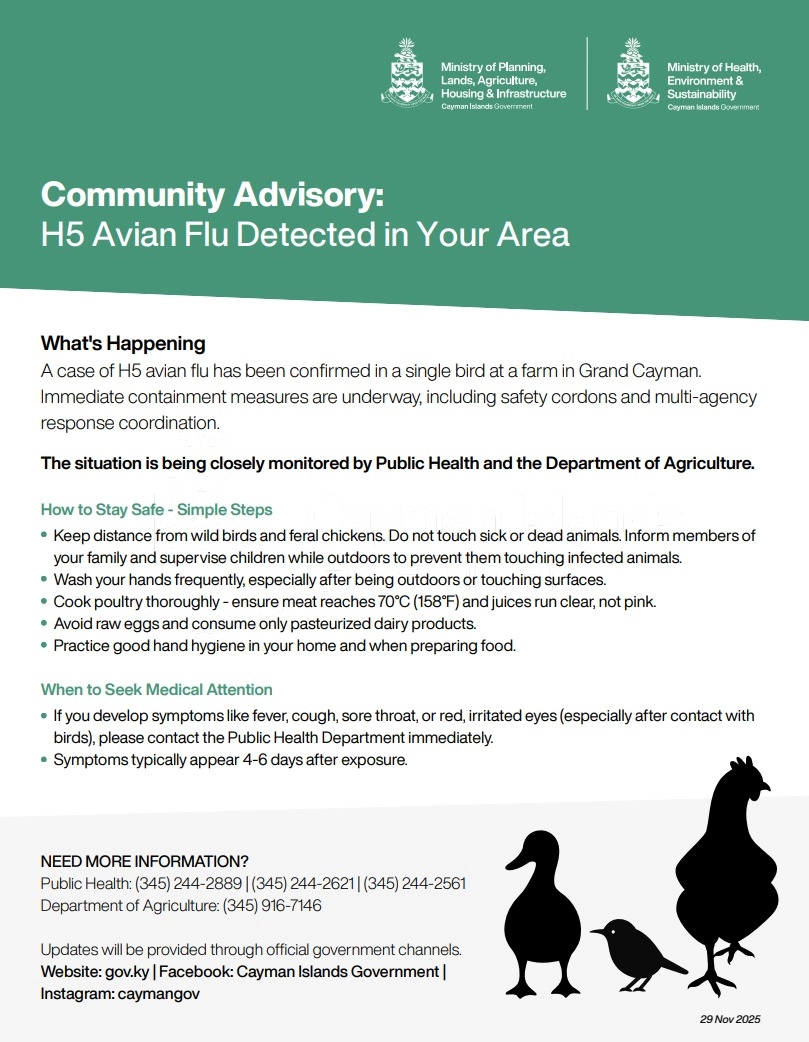
Government teams continued coordinated containment and monitoring activities today, Sunday 30 November, following the confirmed detection of H5N1 Avian Influenza in a limited number of birds at a farm in West Bay. Samples collected from various birds on the farm tested positive for H5N1. All remaining poultry at the site have been removed, and all carcasses are being managed and disposed of in accordance with established public and animal health protocols.
Routine surveillance and sampling continued today across farms and nearby areas, including checks by the Department of Agriculture. Teams are also responding to reports received from the public as part of standard monitoring procedures. These checks do not indicate any additional confirmed sites at this time.
Out of an abundance of caution, additional sanitisation measures in some areas of West Bay. These steps are purely preventative and do not indicate a positive case at these locations. Vehicles and footwear are being disinfected before exiting the area in order to reduce the risk of spread. Members of the public are asked to follow all instructions at these points and to allow extra time if travelling through the area.
Public Health has confirmed that there continue to be no human cases of H5N1 Avian Influenza in the Cayman Islands. Individuals who had direct involvement in initial response work have been tested and all results to date have been negative. The overall risk to the general public remains low.
Chief Medical Officer Dr. Hilary Wolf emphasised that human infection with H5N1 typically occurs only after close contact with infected birds or dead animals. “There is currently no indication of any human illnesses associated with this event,” she said. “We encourage the public to avoid touching sick or dead birds or animals, and to seek medical guidance if they develop symptoms following potential exposure.”
Human symptoms may develop two to fourteen days after exposure and can include fever, cough, sore throat, runny or congested nose, shortness of breath, or red, irritated eyes. Anyone experiencing these symptoms after possible exposure should contact Public Health at 244-2889, 244-2621 or 244-2561.
As monitoring continues, the public is encouraged to be vigilant, follow safety advice, and report any concerns. Farmers are reminded to maintain strong biosecurity practices and to promptly report any suspected illness or dead fowl to the Department of Agriculture.
Key guidance for the community:
Avoid contact with sick or dead birds or other animals.
Do not attempt to handle or cull wild chickens or birds yourself.
Report sick or dead birds or livestock to the Department of Agriculture at 916-7146.
Farmers should remain vigilant with farm-level biosecurity and report any suspected instances immediately.
Wash hands frequently, especially after outdoor activities or contact with animals.
Ensure all poultry is thoroughly cooked and that dairy products are pasteurised.
Seek medical attention if symptoms appear following possible exposure.
Follow only official government sources for updates and information.
Further updates will be provided as operations progress.