



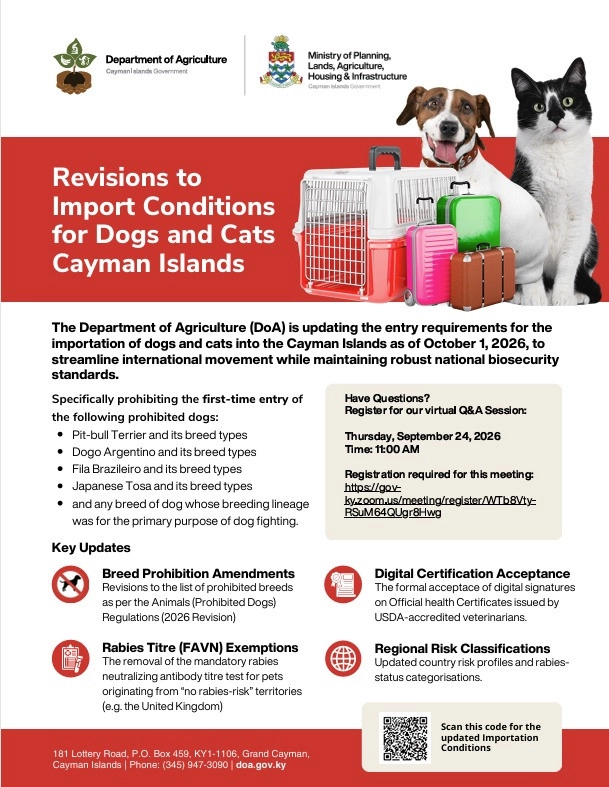
The Cayman Islands Department of Agriculture (DoA), under the Ministry of Planning, Lands, Agriculture, Housing & Infrastructure (MPLAHI), has announced effective October 1, 2026, the revisions to the Conditions Governing the Importation of Dogs and Cats into the Cayman Islands, updating key requirements for the international movement of pets while maintaining the Cayman Islands’ strong animal health and biosecurity safeguards. The revisions are intended to streamline the importance of the import process and provide greater clarity for pet owners, veterinarians, airlines, importers and other stakeholders involved in the movement of dogs and cats into the Cayman Islands. Key Information
1. Updated Prohibited Dog Breed Requirements In accordance with the Animals (Prohibited Dogs) Regulations (2026 Revision), the regulations specifically clarify the prohibition on the first-time entry of the following prohibited dogs:
• Pit Bull Terrier and its breed types;
• Dogo Argentino and its breed types;
• Fila Brazileiro and its breed types;
• Japanese Tosa and its breed types; and
• Any breed of dog whose breeding lineage was for the primary purpose of dog fighting
Pet owners and importers are encouraged to review the prohibited breed requirements carefully before making travel or importation arrangements.
2. Rabies Titer (FAVN) Test Exemption for No-Rabies-Risk Territories
The mandatory rabies neutralizing antibody titre test, commonly known as the FAVN test, has been removed for dogs and cats originating from territories classified as having no rabies risk, such as the United Kingdom. The applicable rabies requirements will continue to be determined according to the rabies-risk classification of the country or territory of origin.
3. Digital Signatures on Official Health Certificates
The revised conditions formally require digital signatures on Official Health Certificates issued by USDA-accredited veterinarians, supporting a more efficient and modern approach to the processing of international pet health documentation.
4. Updated Regional Risk Classifications
Country risk profiles and rabies-status classifications have also been updated. These classifications determine the specific health and documentation requirements applicable to dogs and cats arriving from different countries and territories. Maintaining Biosecurity While Facilitating Pet Travel
The Department of Agriculture encourages anyone planning to bring a dog or cat into the Cayman Islands to review the completely revised import conditions before making travel arrangements, as requirements vary according to the animal’s circumstances and the rabies-risk classification of the country or territory of origin.
Director of Agriculture, Mr. Wilbur Welcome, stated: “These revisions represent an important step in modernizing our import requirements for dogs and cats while maintaining the robust biosecurity safeguards that protect our animal population and the wider community. We want to make the process clearer and more efficient for responsible pet owners and our international partners, without compromising the standards necessary to protect the Cayman Islands.”
The Department also welcomes technical feedback from veterinarians, trade partners and other stakeholders as it finalises the revised document and prepares for the upcoming travel requirements of the pet-owning community. For further information or assistance with the importation of dogs and cats, contact the Department of Agriculture at 947-3090 or agriculture@gov.ky.