

The Cayman Islands Government has taken another key step toward developing the Cayman Islands Resilience Index (CIRI), a new decision‑making tool designed to track how well the country is preparing for climate impacts.
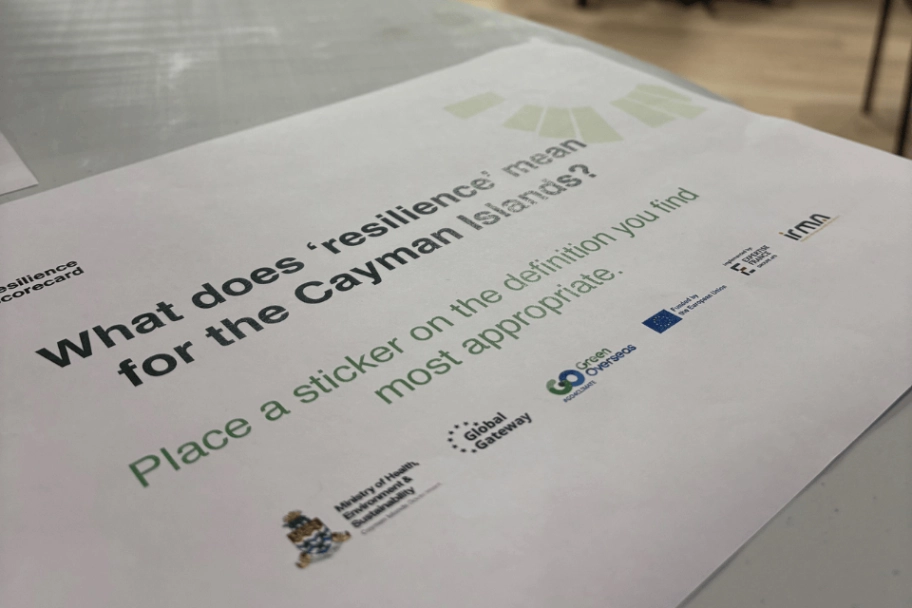
On Wednesday 11 February, the Ministry for Health, Environment and Sustainability (MHES) hosted an inter‑agency design workshop at the Intergenerational Hub. The session brought together representatives from more than 20 government ministries and departments, along with non‑government partners, to help shape how the index will work and what information it will use. Consultants from Integrated Risk Management Associates LLC (IRMA), who are supporting the project, facilitated the day‑long workshop.
The National Resilience project officially began in July 2025 and is funded by the European Union through the Green Overseas (GO) Programme. It is being implemented by MHES in partnership with Expertise France and IRMA, and will run over 11 months to deliver both the index and an online platform that can define, measure and monitor climate resilience across the Cayman Islands.
The initiative stems from a key strategic action in the Cayman Islands Climate Change Policy 2024–2050 and is being designed to reflect its main focus areas, including the economy, infrastructure, communities, the built environment and nature. According to Government, the Resilience Index will support stronger planning and help safeguard communities, infrastructure and the wider economy from increasing climate risks.
Health, Environment and Sustainability Minister Hon. Katherine Ebanks‑Wilks said the workshop was an important opportunity to bring different perspectives into the design process and to think about how policies and projects affect the country’s ability to cope with climate change.
“Climate impacts every aspect of society, and the tool that we are developing will be focusing a lot more than measuring how ‘green’ we are as a country. Rather, this is about enhancing our resilience and future-proofing across all sectors of society and our economy to ensure our continued prosperity,” she said.
Throughout the workshop, attendees heard an update from IRMA on work completed so far, including early findings from a benchmark study of similar tools and feedback gathered through stakeholder surveys. Participants also discussed which indicators should be included, how the platform should be maintained over time and the kinds of risks and challenges it needs to capture across all three islands.
As part of the session, stakeholders also agreed on a new name for the tool. They selected “Cayman Islands Resilience Index” (CIRI), which will now be used as the official title.
So far, the project team has produced an inception report outlining the objectives and milestones, carried out a benchmark analysis of resilience tools used elsewhere, and conducted surveys and focus group discussions with public and private stakeholders to understand their expectations for the index. Next steps include using the insights from the workshop to refine the system design and begin developing a prototype of the CIRI platform.
Officials say the Resilience Index is expected to guide future public and private investment decisions, improve access to climate finance and increase transparency about Cayman’s progress toward climate resilience. The lessons learned could also provide a useful example for other Overseas Territories and island jurisdictions facing similar climate challenges.