



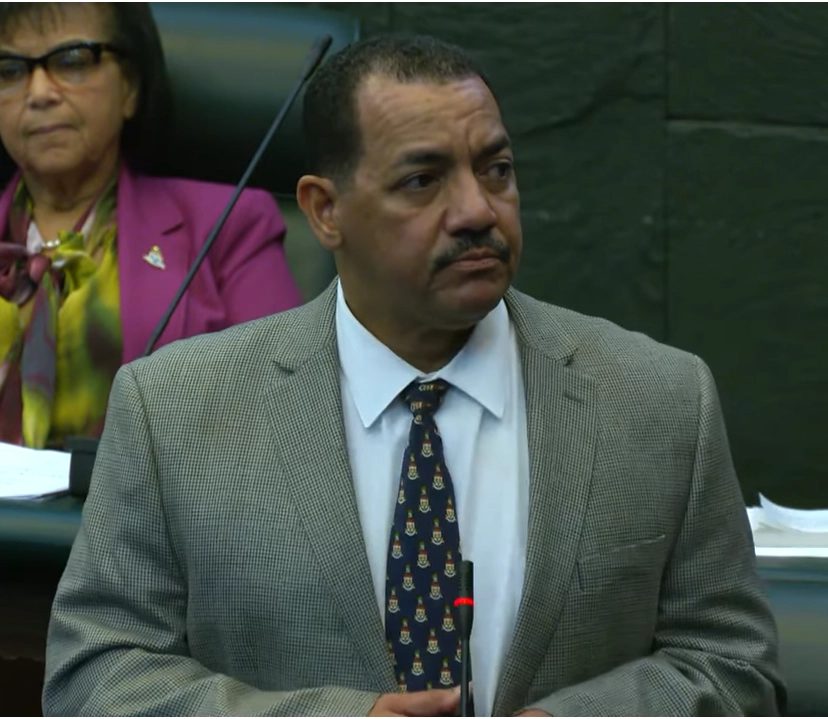
In Parliament on Friday, 12 December 2025, Minister for Finance and Economic Development Hon. Rolston Anglin steered through legislation and regulations which will increase stamp duty on the transfer of properties worth $2 million dollars or more, and also increase the taxes charged on share transfers valued at $2 million or higher in land holding companies.
Both are pursuant to the 2026-2027 Budget passed in Finance Committee on 21 November, 2025 and are necessary in order that the Cayman Islands Government may collect the increased stamp duty rates necessary to raise revenue as projected from 1 January, 2026.
The Stamp Duty (Rates of Duty) (No. 2) Regulations, 2025 – which came into effect 1 January 2026 - will increase stamp duty rates from 7.5 percent to 10 percent on the conveyance or transfer of properties — developed or undeveloped — where the consideration (market value or purchase price, whichever is higher) is CI$2 million or more.
After tabling the Regulations, Minister Anglin noted that stamp duty and property transfers are a significant and reliable source of revenue to the Government.
He explained, “The unaudited financial results for 2024 show that Government collected some $88.735 million of stamp duty on property transfers, substantially exceeding the approved budget that year of $67.5 million. Further analysis by the Lands and Survey Department indicates that $35.641 million or 40.1 percent of this duty is related to property transfers in the $2 million and above bracket. In 2025, stamp duty revenues continue to be a star performer with some $87.826 million collected as of the 30th of November 2025, already surpassing the approved 2025 budget of $76.1 million.”
The Finance Minister further revealed that the new stamp duty rates are expected to generate additional revenue of $11.7 million in 2026 and $11.2 million in 2027, which will support the Government's ability to achieve the forecast financial results set out in the 2026 and 2027 budget.
In an announcement, - welcomed by Minister responsible for Housing, Hon. Jay Ebanks, Minister Anglin said he was happy to report that the Ministry of Finance and Economic Development has committed to tracking the increase in high-end property stamp duty during the 2026 and 2027 budget cycle and earmarking one percent of the 2.5 percent increase for housing, housing-related improvement projects and buildings for Caymanians.
Minister Anglin explained the rationale behind this decision, saying, “This is a Government that is laser focused on improving the lives of all of the people whom we serve. I can say beyond, beyond any doubt that Caymanians who reside in every constituency of whom we represent are going to be happy to hear that we are going to be ensuring that we start to identify additional funds for affordable housing and housing-related projects.”
Noting that Caymanians “have been in large measure crowded out of the property market because of skyrocketing values in the Cayman Islands”, Minister Anglin said it is critically important to get more Caymanians on the property ladder and that he was pleased to be making this announcement just before Christmas.
The Finance Minister also took the opportunity to note the care and reasoning behind increasing stamp duty in the category of high-end properties only.
He said, “In determining this revenue measure, the Government took care to set a threshold that will not impact or unduly burden the ordinary person. A person acquiring property valued CI $2 million or more is by definition operating at the top end of the market and it is reasonable to expect that such purchasers have the capacity to pay an additional 2.5% in stamp duty.”
Minister Anglin continued, “This, Mr. Speaker, is targeted for anyone who qualifies and is able to acquire properties of CI$2 million or more. This is not going to hit the average man. In crafting this budget, the Government was extremely careful to ensure that our revenue measures were specifically targeted to ensure that any impacts on the local economy and what we would call the average Caymanian, would be little to none.”
The Land Holding Companies Share Transfer Tax (Amendment) Act, 2025 complements the Stamp Duty Act by imposing a tax equivalent to stamp duty where there is a change in the beneficial ownership of land in the Cayman Islands through the transfer of shares in a company that owns that land.
The Land Holding Companies Share Transfer Tax Act (2022 Revision) applies a standard rate of 7.5% to taxable transfers of shares in a land holding company. The Land Holding Companies Share Transfer Tax (Amendment) Act , 2025 introduces a new tier by applying a rate of 10% to taxable share transfers where the consideration or taxable value of the share transfer is CI$2 million or higher.
Minister Anglin noted that this Act is not expected to generate significant additional revenue in its own right, but it is intended to ensure that there is consistency with the land holding companies share transfer tax and stamp duty regimes and that Government revenue is protected.
He explained, “Its purpose is to protect Government’s revenue base by preventing the potential loss of revenue that could occur if persons seek to avoid the higher stamp duty rate on high-value property transactions by structuring a transfer as a share transfer in a company that holds the property, rather than a direct conveyance of the property itself.”