


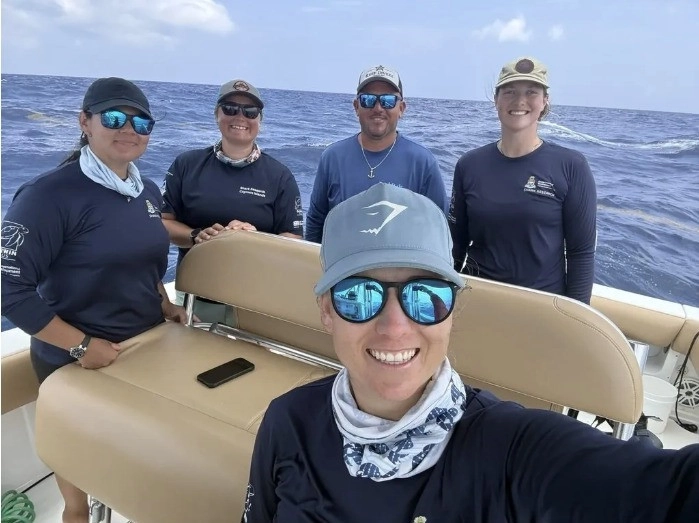
The Cayman Islands Department of Environment (DoE) has been actively testing the “Rpelx” electromagnetic shark deterrent device with local anglers to prevent sharks from taking hooked fish. Reducing the loss of catch and tackle to sharks helps fishermen while also reducing the impact of fishing activities on Cayman’s breeding shark population. In response to concerns expressed by local anglers, the DoE secured funding from the UK Government through Darwin Plus for a new 3-year shark research project earlier this year. In July DoE began trials with the Rpelx device with local anglers who fish for deep water snapper.
“It was great to show the DoE shark team how sharks affect the fishing experience,” said Captain Stephen Ebanks who runs local fishing charter Reel Vibes. “We immediately got sharked on the first drop. This happens all the time, in some areas more than in others but it is a problem and I am glad the DoE is working on a solution.”
The trial aims to collect data on 200 deep drops, 100 with the Rpelx and 100 without the device. “For a successful trial, we rely on the fishing community to help. Anglers fish while we collect the data,” explains Dr Johanna Kohler, Manager of the Shark Research & Conservation Programme at the DoE.
“We also measure each fish and note the species,” said Anne Veeder, Research Officer with the DoE Shark Research & Conservation Programme. “This way, by the end of the trial the DoE can provide meaningful results to the fishing community such as whether the device affects the catch rate, number, size or species of fish, and whether it is successfully managing to deter sharks.”
The trial consists of an experimental set up so that researchers can compare the effectiveness of the Rpelx device to deter sharks. During fishing trips, the following data is collected when fishing both with and without the device: environmental conditions, boat length, engine type, location, depth, time taken until first bite, fight time, reel type (standard vs electric), and how many fish, hooks, sinkers are lost to sharks, and how many fish are landed intact.
If the device proves successful in deterring sharks without major impacts on the fishing experience, the project will move on to phase two of the trial where the DoE will purchase and provide the Rpelx device to local anglers to keep and report back on the long-term effects.
“We have completed 62 deep drops so far, which is just over ¼ of the target number,” said Dr Kohler. To move on to the second phase of the trial, it is essential to collect enough data for the statistical analysis. The DoE aims to complete the total of 200 deep drops by the end of September or beginning of October.
Please reach contact sharks@gov.ky or WhatsApp 926-0135 if you go fishing for deep water snappers and want to collect more data for this Rpelx shark deterrent device trial.
“We need robust evidence that the Rpelx device works for anglers in Cayman to justify the expense of purchasing more devices,” explained Dr Kohler. “The more help we can get with testing the device now, the quicker we can move on to phase two so fishermen can have their own device full-time.”
Project Background
This project addresses the reported and apparent rise in interactions with sharks during fishing trips. “These unwanted encounters impact not only the fishing experience but also reduce the number of fish that anglers land and often result in the loss of fishing tackle.” said Captain Erick Adam, owner of local fishing charters Sea Cayman Boat Charters and Grand Time Watersports. King Flowers, owner of the Brasserie adds “If it happens one time, that is fine. But on some days, we only get a quarter of the usual catch and the time for repairs of the fishing tackle add up quickly.”
The DoE hopes to balance marine conservation with local fishing activities. “We understand fishermen’s frustrations because the shark is not the target, but it interferes with the catch of target fish and fishermen have no tool to avoid these interactions with sharks,” shared Dr Kohler. “It is hoped that the electromagnetic shark deterrent device can be an effective tool for fishermen to avoid losses of catch and tackle to sharks,” said Dr Kohler.
The Rpelx device emits a 200-volt electromagnetic field around the hooked fish and takes advantage of the shark’s physiology. Sharks have electromagnetic receptors called “Ampullae of Lorenzini”, but the other fish do not. When the shark approaches the hooked fish, it eventually enters the electromagnetic field of the device and the shark’s electromagnetic receptors get over stimulated. “To the shark it feels like a strong punch in the face, and it will turn away,” explains Dr Kohler.
Sharks eat sick and weak individual fish so they will naturally be present where there are lots of fish. A hooked fish struggling on the line, with potentially fish blood in the water, sends out signals that an injured fish is nearby which will attract sharks. While this behaviour is natural, these interactions have serious implications not just financially for fishermen and charter businesses, but also on the health of individual sharks. “We have had reports from divers with the citizen science Sharklogger Network, of individual sharks swimming around with hooks, deep wounds, injured fins, and even a gaff stuck in the jaw” said Ms Veeder.
Most of these interactions involve large individual sharks that are part of the breeding population, potentially including pregnant females. Pregnancy is a vulnerable life-stage in any population and the health impacts of unwanted encounters with fishermen could potentially cause a loss of pregnancy or death of both the pregnant female and her unborn young. “We want to improve the survival of the most vulnerable life-stages of our coastal sharks. So given the trial’s success so far, we hope the Rpelx device will help fishermen increase their catch while also supporting the survival of Cayman’s sharks, particularly in vulnerable life-stages such as pregnant females and newborns,” said Dr Kohler.
This project is funded by the UK Government through Darwin Plus and the Cayman Islands Brewery through donations from sales of White Tip Lager.