



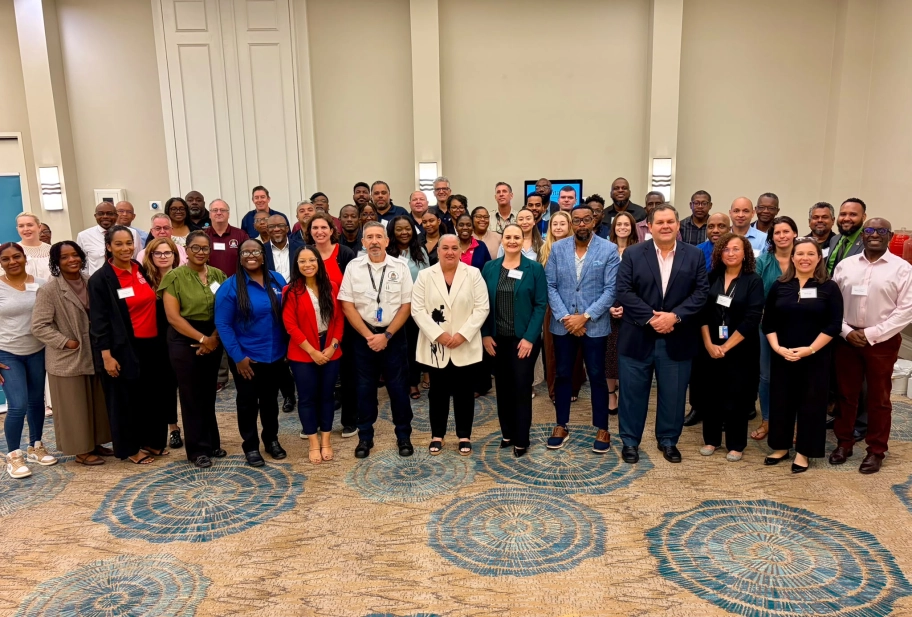
The Ministry of Health, Environment and Sustainability (MHES) has launched the Cayman Islands Government’s first Health, Safety and Environment (HSE) Management System, designed to improve how staff in high-risk departments identify workplace hazards, report incidents and follow up on safety concerns.
The Department of Environmental Health (DEH) and the Mosquito Research and Control Unit (MRCU) will initially pilot the programme, allowing MHES to evaluate its effectiveness and identify opportunities for further development. This will help inform ongoing collaboration with the Portfolio of the Civil Service (PoCS) and other relevant stakeholders to explore opportunities for its potential expansion across the Cayman Islands Government.
The Ministry launched its HSE Vision and Management System on Thursday, 12 November 2026, at the Grand Cayman Marriott Resort. The event was attended by Deputy Governor and Head of the Civil Service the Hon. Gloria McField-Nixon, Hon G. Wayne Panton, Parliamentary Secretary in his capacity as Acting Minister, MHES Chief Officer Ms Tamara Ebanks and staff from across the Ministry and all its departments and statutory authorities.
The management system is the first of its kind within the Ministry and establishes a structured approach to strengthening governance, leadership and accountability through standardised workplace HSE Standard Operating Procedures (SOPs), incident reporting and investigations, inspections, audits, hazard observations, safety meetings, performance monitoring, dashboards and analytics.
Minister Ebanks-Wilks, who was away on official business, addressed the launch in a recorded message, saying: “Every civil servant deserves a safe working day and a safe return home. When I outlined this initiative in Parliament, I wanted staff to see practical changes in how we manage risks at work. Starting with two departments gives us a chance to learn directly from the people who will use the system.
“This launch is a critical step in the advancement of the health and safety of all workers in the Cayman Islands. By leading by example within the Ministry, we are demonstrating how a safety-first culture can be adopted, implemented and ultimately save lives.”
The HSE pilot programme aims to highlight the importance of recognising, adopting, and championing a proactive HSE Management System as a critical safeguard for employee wellbeing, operational resilience, and regulatory excellence.
The Deputy Governor, the Honourable Gloria McField-Nixon, welcomed the programme in her remarks at the launch.
“As the largest employer in the Cayman Islands, we have an obligation to make sure every employee gets home safely at the end of the day. Some of our colleagues in the Ministry of Health, Environment and Sustainability, such as departments like the MRCU and DEH, perform essential work that carries real risks. We owe it to them and similar departments across CIG, to identify those risks early and to give them clear guidance on how to work safely.
“This programme also gives us a consistent way to record incidents, learn what went wrong and take action to prevent them from happening again. It’s something we’ve wanted to address for some time, and I’m delighted to see the Ministry of Health, Environment and Sustainability lead this work.”
The pilot is being led by the Ministry’s Health, Safety and Environment Specialist, Mr Osei Alexander. He said: “I am grateful to the Deputy Governor, the Minister, our Chief Officer and Deputy Chief Officer for their continued support, confidence and commitment to advancing this important initiative.
“This system will support the Government's wider priorities of protecting employee health, safety and wellbeing as highlighted within the CIG Strategic Policy Statement (SPS) 2026-2028. Safety is everyone's responsibility, and by establishing a structured approach to reporting and investigating incidents, accidents and near-misses, identifying hazards, monitoring performance and implementing corrective actions, we can learn from our experiences, proactively manage risks and work towards preventing future incidents.
“Ultimately, this is about building a culture where health, safety and environmental responsibility are embedded in how we think, lead and work every day.”
The HSE Leadership Charter
A key moment in the official launch of the HSE Management System was the signing of the HSE Leadership Charter by Parliamentary Secretary the Hon. G. Wayne Panton and Chief Officer Ms Tamara Ebanks. The Charter is a pledge by the Ministry's leadership that protecting the health, safety and welfare of our people is a fundamental leadership responsibility. In signing it, leaders commit to lead by example, take ownership and accountability, provide the resources teams need, manage workplace risks, act on concerns, encourage staff to speak openly about safety and keep strengthening the HSE Management System. Minister Ebanks-Wilks will add her signature to the Charter on her return.
Chief Officer Tamara Ebanks said, “The Leadership Charter sets out what staff should expect from us as leaders. We want staff to feel safe and empowered to speak up, and when someone raises a safety concern – they should know who will follow it up and what action is being taken. It is our responsibility to make sure that happens.
“Workplace health and safety is not simply a matter of good practice. It is also an established responsibility under the Public Service Management Act. Section 55(2) places a responsibility on the Chief Officer to establish workplace safety procedures within the civil service entity, consistent with the Personnel Regulations, to protect the health, safety and welfare of staff.
“For our Ministry, this means ensuring that this responsibility is reflected in our management arrangements, the policies and procedures we establish and the decisions we make every day.”
Staff in attendance had the opportunity to ask further questions about how the system would work in practice during a panel discussion with Deputy Chief Medical Officer Dr Mark Paramlall and Mr Osei Alexander.
In another highlight of the event’s agenda, guest speaker Mr Jason Brown, Managing Director of Island Waste Carriers, was invited to give a presentation on how organisations can build a culture of safety in practice. He explained how routine equipment checks and regular safety discussions help his teams identify problems early and learn from incidents.
HSE legislation is being developed alongside the Management System and will eventually extend to the private sector. In this context, Mr Brown’s contribution offered valuable insight into how a company can fully embrace HSE practices to operate more safely and effectively, drawing on the measures he is already putting into practice.
HSE Software Training
The Ministry has procured and approved VelocityEHS, a digital HSE Management System solution that will facilitate incident reporting and case management, tracking and the monitoring of corrective and follow-up actions.
Leaders and designated personnel from both pilot departments participated in two training workshops coordinated by the Ministry and delivered by VelocityEHS ahead of the launch.
The sessions covered Incident Reporting and Investigation, followed by Inspections, Audits and Safety Meetings, providing participants with practical guidance on using the system to support these essential HSE functions.
Next steps
The first phase of implementation will involve configuring the VelocityEHS software, establishing access for designated and authorised users, developing the necessary reporting forms and finalising the Ministry's HSE Standard Operating Procedures (SOPs) for formal approval, roll out and implementation.
In parallel, the Ministry is strengthening HSE awareness and workplace culture through two dedicated video presentations: the Ministry’s Life-Saving Rules and an HSE Induction/Orientation. All employees, both existing staff and new recruits, will complete both presentations, so that everyone receives consistent HSE messaging and understands their individual responsibilities. Each department will document completion to support accountability and monitoring.
Deputy Chief Officer for Health Ms Exie Tomlinson-Panton, under whose remit the initiative falls, and who served as Master of Ceremonies for the launch, said: “Today marks the launch, but the real work begins now. We are working to have this first phase fully in place by early February 2027 and meeting that target will depend on every one of us.
“What we ask of our people is clear. To our directors: I am asking each of you to take ownership of the HSE Management System and ensure it is fully implemented across your respective areas, beginning with DEH and MRCU, while our other departments prepare to follow.
“To our managers and supervisors: you are the link between our leadership’s commitment and what happens in the workplace and in the field. Beyond taking part in training and setting the example, you must ensure that HSE requirements are communicated, understood and consistently applied by your teams. That means overseeing compliance with our procedures, addressing unsafe acts and conditions when you see them, and making HSE part of everyday operations.
“To every member of staff: complete your induction and required training, follow the HSE policies, procedures and safe working practices being introduced, and report hazards, incidents, and near-misses. Each of us has a responsibility to protect ourselves and those around us. A safety system only protects people when everyone plays their part.”