



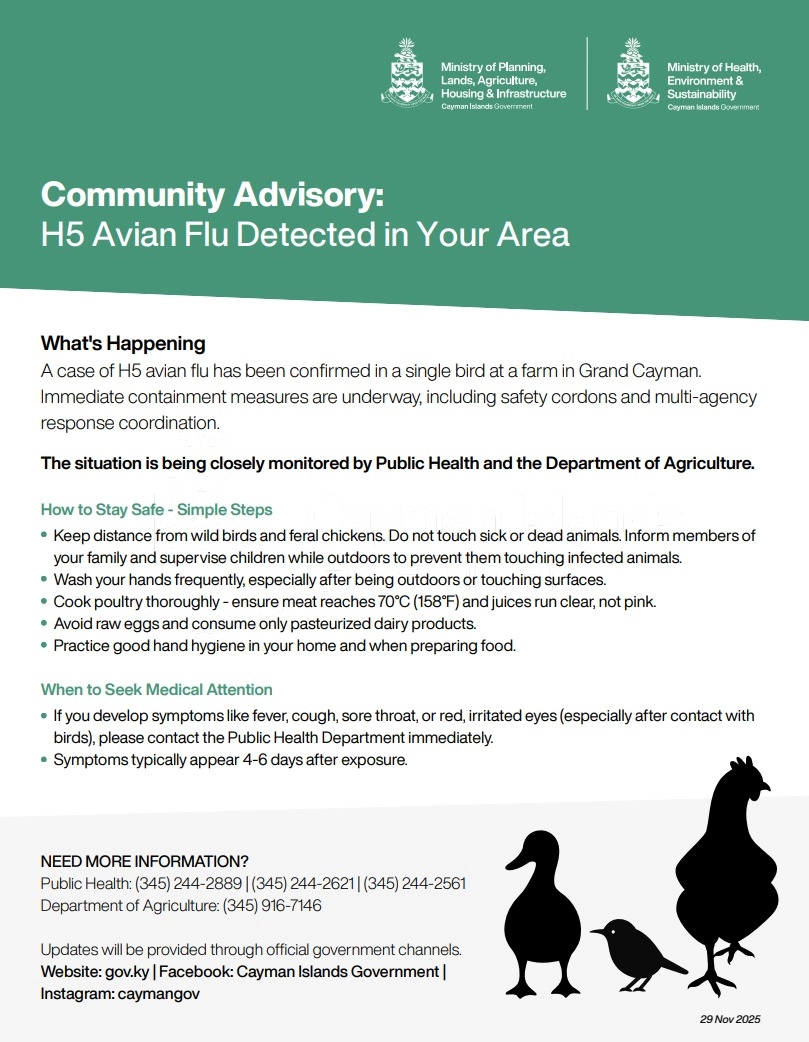
Multiple government agencies have been focused on containment and risk mitigation today, Saturday 29 November, following the detection of the H5N1 Avian Flu on Grand Cayman. Coordinated by Hazard Management Cayman Islands, strategic and tactical responses have been undertaken by the Department of Agriculture, Public Health Department, Department of Environment, Department of Environmental Health (DEH), Royal Cayman Islands Police Service (RCIPS), the Cayman Islands Regiment and a number of other agencies.
The Department of Agriculture (DoA) has begun the depopulation of birds within the impacted area and collected samples for testing by the Cayman Islands Laboratory, with results thus far as 7 positive additional cases. Special permission has been granted to DoA to cull feral birds at the site and the added area of observation. The Department of Environmental Health (DEH) has received and contained carcasses of animals suspected to be contaminated and will dispose of them tomorrow Sunday, 30 November by incineration.
The Department of Environment is currently monitoring for birds that may be displaying symptoms of H5N1 Avian Flu. All agencies are taking the necessary precautions including wearing Personal Protective Equipment (PPE), disinfecting before and after entering the cordoned areas.
“It is highly important that the public does not interact with sick birds during this period, and report any sightings of birds that show signs of sickness. The collaborative approach by our agencies to prevent an outbreak requires cooperation from the community to be vigilant, and to limit their own exposure”, said Director of Agriculture Wilbur Welcome.
As of 9pm today, there are still no confirmed cases of avian influenza in humans in the Cayman Islands. The public is reminded that symptoms of avian flu in humans usually start 4 to 6 days after being in contact with an infected bird. Symptoms can range from mild to severe, and include high temperature, cough, sore throat, runny or blocked nose, wheezing and sneezing, shortness of breath, and red, irritated eyes (conjunctivitis).
The community is reminded that they should only trust reports from official sources and channels as the situation continues to develop.
Key recommendations:
Updates on the situation will be provided to the public through official government channels. The public and especially concerned farmers or owners of birds/fowls are encouraged to contact the Department of Agriculture at 916-7146 with any concerns.