



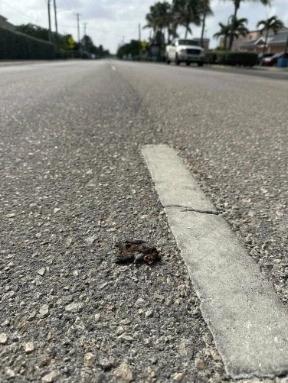
Earlier this week in East End, five sea turtle hatchlings were found dead near a beachfront property, one was crushed on the road, and 12 more were found alive nearby. All had been led away from the sea by artificial lighting.
The incident follows two other serious hatchling misorientations in Grand Cayman last week.
On Seven Mile Beach, multiple hatchling tracks led away from the sea and towards a beachfront building. Hatchlings ended up in the swimming pool, the pool drain, and far along the side of the property. One was found dead on the pool deck.
In Bodden Town, hatchlings from another nest led towards a roadway and bright security light instead of the sea. Most disappeared into the surrounding area and could not be found afterwards.
Likely few, if any, reached the ocean. One was later found alive near a roadside home and brought to the Department of Environment in a cereal bowl by a member of the public.
When a nest hatches, all the hatchlings emerge together from the sand, sometimes more than 100 at one time. They find the sea by looking for light from the moon and stars reflected on the ocean surface and moving away from dark shadows such as natural beach vegetation. Artificial lights can overpower those cues and lead the whole group in the wrong direction.
So far this season, hatchling misorientations have been recorded from 15 nests – 13 in Grand Cayman and two in Cayman Brac. Together, those nests produced over 1,000 hatchlings, many of which didn’t make it to the sea.
“A newly emerged hatchling is only a couple of inches long, but it is driven by a powerful instinct to reach the sea,” said Dr Janice Blumenthal, a Senior Research Officer at the Department of Environment. “When we light the beach, we hijack their natural instinct. find hatchlings around buildings, pools and roads, exhausted or dead. They fight with everything they have to keep going, but our lights are leading them away from the sea.”
More than 1,200 sea turtle nests have now been recorded across the Cayman Islands this season, a record nest count. Some beachfront properties may see 50 nests this season, while others are seeing turtles nest for the first time. Beachfront properties should not wait until a nest is known to be nearby to change harmful lighting.
“Every non-turtle-friendly light that is visible from the beach is a danger to hatchlings,” Blumenthal said.
“There’s a simple test: look at your property from the beach after dark. If you do not have turtle-friendly lighting and your lights are visible from the beach, turn them off throughout the nesting season or change them to turtle-friendly alternatives.
Turtle-friendly lighting is now a standard part of beachfront development in Cayman. It is already required for new beachfront properties through the planning process, and more existing properties are making the switch.
“Property owners can contact DoE for help with turtle-friendly lighting. We can help design lighting that meets the needs of the property without illuminating the nesting beach or putting hatchlings at risk.”
There is also an important warning for property owners buying turtle-friendly lighting. Some properties have specifically asked suppliers for turtle-friendly lighting, but have been sold products that were not actually turtle-friendly.
It is heartbreaking when people have tried to help, bought lights sold as turtle-friendly, paid to have them installed, and only then find out that those lights can still misorient hatchlings,” Blumenthal said. “Before you buy, check with DoE. Even certified turtle-friendly fixtures have to be suitable for where they will be used, and they still have to be positioned, directed and shielded correctly. We can help you choose lighting that works for the property without creating a threat to turtles.”
Anyone who finds hatchlings heading away from the sea, or a turtle in distress, should contact the DoE Turtle Hotline at 938-NEST (938-6378).
For information about turtle-friendly lighting, visit www.doe.ky/tfl or email emu.doe@gov.ky.