


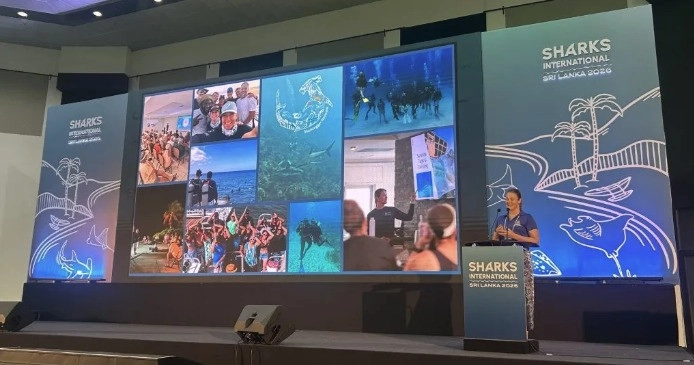
The world's largest shark conference “Sharks International” brought together more than 800 researchers, conservationists, and policymakers from 81 countries including two representatives from the Cayman Islands. Dr Johanna Kohler and Anne Veeder of the Department of Environment’s Shark Research & Conservation Programme were honoured to take part in discussions on overfishing and the shark meat trade, as well as emerging conservation technologies and community-led solutions.
“This conference happens only every 4 years. It is incredibly special and rewarding to be able to meet and exchange expertise with other passionate researchers that work towards the same goals as we are here in Cayman”, explains Dr Kohler.
The international community highlighted the scale of the challenges ahead and the innovative work already underway to better understand, monitor, and protect these keystone species, many of which are threatened by extinction.
As part of the five-day conference, Dr. Johanna Kohler presented Cayman’s latest discoveries of deep-sea sharks and the recurrence of a school of scalloped hammerheads to a global audience of around 300 people. Anne Veeder presented DoE’s citizen science programme, the Sharklogger Network, highlighting how long-term monitoring, with help of volunteer participants combined with local Covid-19 regulations, was used to evaluate the human impact on shark populations in the Cayman Islands.
“Sharks International reaffirmed the need for collaboration in our scientific community, made evident by knowledge and past experiences shared amongst this global cohort. I am grateful to bring knowledge gained from the workshops ‘Techniques and Technologies for Shark Research’ and ‘Elasmobranchs as macrohabitats: Parasites as key players in marine ecosystems’ back to Cayman and have the support and guidance of other citizen science programs featured alongside the Sharklogger Network,” explained Veeder.
The team also participated in four specialised workshops on shark conservation challenges and solutions relevant to Cayman. Across panels, workshops, and conversations throughout the week, they were able to share experiences from Cayman while gaining insights into lessons learned from other research teams.
DoE presented two talks at the conference which are available to watch online:
WATCH Dr Kohler's presentation on Deep Sea Discoveries:
https://youtu.be/hRNdho2l4xw?si=RfuYBQyky9Lw4-c8&t=5482
WATCH Anne Veeder's presentation on the Shark Logger Network:
https://youtu.be/JkHvL6_N1gA?si=CuUaYxPGwH_vy90L&t=3718
Learn more about Cayman's sharks and check out the scientific publications informing these presentations at www.doe.ky/sharks.
This work is made possible through the support of the Cayman Islands Brewery via donations from sales of White Tip Lager, and through Darwin Plus funding from the UK government.