

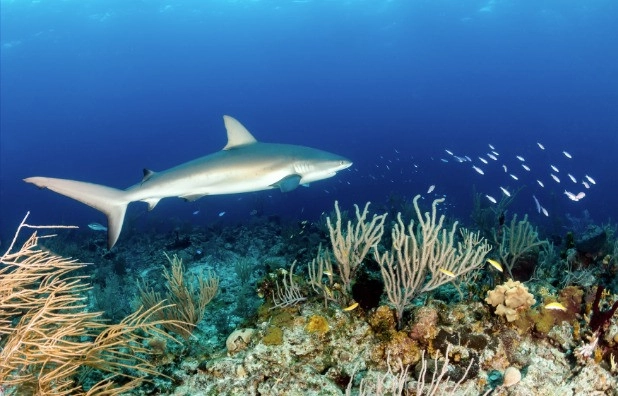
A new 3-year study aiming to “Safeguard vulnerable life-stages of shark populations in the Cayman Islands” will move ahead after a Darwin Plus grant from the UK Government was secured by the Department of Environment (DoE). Dr Johanna Kohler, Manager of the Department of Environment’s shark research & conservation program, expressed both relief and anticipation in learning the application had been awarded. “We are grateful to be one of five UKOT applications that were successful. Darwin Plus funding is highly competitive and the application process is a lot of work over many months. We really had to show the benefits that this study will bring to the Cayman Islands and present a robust, evidence-based, scientific project design. Now that we’re approved, we can focus on getting the logistics in place to begin this critical research.” The project aims to address two predominant shark conservation concerns. The first involves frequent reports of unwanted shark encounters from fishermen, most likely involving sharks that are part of the breeding population, including pregnant females. The second is the number of dead shark reports every year, many of which are very young sharks. To understand these concerns better, the project will examine the reproductive ecology of local sharks by collecting data with a variety of methods and testing a novel fishing device that electronically deters sharks. “We don’t know the full life cycle of shark species that reside in Cayman. In the past this type of research required intensive time and human resources as well as lethal methods which were undesirable for the DoE. There were also no effective tools available for fishermen to avoid unwanted shark encounters. But now, we can harness new technologies to really dig deeper into the life cycles of these incredible species” explained Dr Kohler. The new study builds on existing non-lethal methodologies like satellite telemetry and shark sex hormones, while repurposing existing ultrasonography – a portable, ultra-sound machine specifically designed for marine field work. DoE’s efforts are supported through experts led by Dr James Sulikowski, Director of the Big Fig Lab at Oregon State University. Additional information collected from DoE’s locally developed citizen science programme, the Sharklogger Network, and new innovations like Birth-Alert-Tags, will help reveal key life-events and collect granular data on the reproductive ecology for endangered Caribbean reef sharks and potentially, for other coastal shark species as well. The project’s second objective is to reduce unwanted shark encounters. Volunteer fishermen will test a shark deterrent system called ‘Rplex’ which has proven effective in Australia to increase fish catch, reduce loss of catch and tackle to sharks, and to reduce accidental by-catch of sharks. DoE will assess the effectiveness of the fishing device with volunteer fishermen in the coming months. Dr Kohler explained how the devices work and why they are a key component to the project. “Since sharks are naturally attracted by struggling fish hooked on the line and fish blood in the water, the ‘Rplex’ can help fishermen by creating an electronic “fence” around the hooked fish that overstimulates the sharks’ electro-receptors causing them to avoid the area. Target fish do not have electro receptors so the device will only deter sharks and not fish in general. After two decades of shark protection laws, research and conservation education in Cayman, we can see that people have changed their attitudes and behaviours around sharks. Fishermen do not target sharks anymore and if accidentally caught, most make an effort to release them as unharmed as possible. Offering the ‘Rplex’ as an additional measure to avoid unwanted shark encounters will benefit both the fishing community and our vulnerable shark populations. It’s a win-win.” The DoE will offer a workshop on March 24th from 5:00-7:30pm for fishermen interested in participating in the shark deterrent study. John Bothwell, Manager of the Legislation Unit at DoE explained how the findings will improve the effectiveness of existing Marine Parks and national shark protections, while advancing the islands’ conservation commitments. “As we celebrate 40 years of Marine Parks in the Cayman Islands, it is timely that we secure the funding support needed to better understand the life cycles of these keystone species which are critical to the health of our oceans. This also fulfils local and international conservation commitments to improve long-term conservation of biodiversity in the Cayman Islands with robust, evidence-based policy and best practices.” With many of the outcomes of the project being community-led, volunteers are invited to participate in our citizen science programme, the Sharklogger Network. Local divers and snorkelers that want to log their dives for shark research can join by contacting the DoE Shark Research Team. “At the final stage of the project, we will look at the data and engage with the community and relevant organisations to discuss possible mitigation responses”, says Dr Kohler. “We want to develop solutions together with the people”. To get involved, contact the DoE shark research team at sharksloggers@gmail.com Sign up for the DoE shark deterrent workshop at https://forms.gle/GvBTjpPZPPSSpHZU9 (deadline Fri 20th March 2026) Learn more about Cayman’s sharks at www.doe.ky/sharks Learn more about the Darwin Plus grant at: https://darwinplus.org.uk/project/DPLUS225 DoE’s Shark Research & Conservation Programme is supported by the Cayman Island Brewery through the White Tip Lager Conservation Programme.