
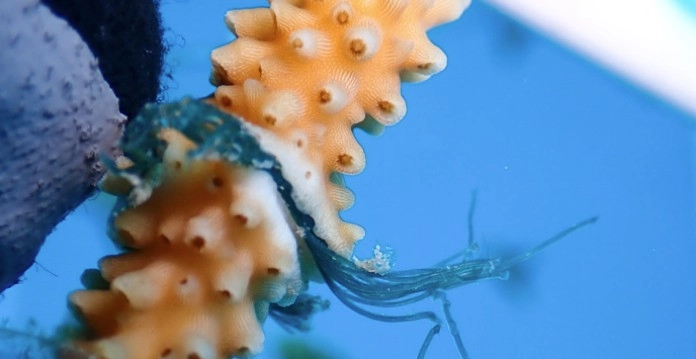
On June 1, 2026, the Department of Environment (DoE) identified 70 + fragments of Staghorn coral (Acropora cervicornis) in a coral nursery that had been set up at Smith Cove without the necessary National Conservation Council (NCC) permit permission.
The structure was placed on the natural reef, contravening several provisions of the National Conservation Act 2013 (NCA), which carries a penalty of up to CI $ 500,000 and/or four (4) years in jail. Following removal of the structure, the coral fragments were relocated to the DoE’s nursery at Northwest Point, where they will be cared for and monitored as part of the Department’s coral restoration project.
Nursery Details
The illegal nursery consisted of ropes that were secured directly to both dead and living boulder corals. This attachment can potentially harm living corals through breakage and abrasion. Additionally, the materials used had begun to fray, which may complicate growth for the corals attached to them. In contrast, approved restoration projects use specially designed attachment systems that aim to reduce impacts and promote coral health.
Conservation Status
Like all corals in the Cayman Islands, Acropora cervicornis is protected at all times under Schedule 1, Part 1 of the National Conservation Act (2013). This species is listed as Critically Endangered on the IUCN Red List, reflecting the severe population declines experienced throughout the Caribbean.
It is also classified globally as an ‘EDGE’ species (evolutionary distinct and globally endangered). Following the severe mass bleaching event of 2023, Staghorn coral faced significant mortality in the Cayman Islands, resulting in only a few isolated colonies remaining in the wild. Preserving these colonies is crucial for maintaining genetic diversity.
Permitting Information
The Department emphasizes that no permits have been granted for new coral nurseries or the removal of corals from the wild. This position is based on:
Successful coral restoration is a complex process that involves careful planning, genetic management, disease monitoring, and ongoing maintenance.
Public Awareness
It is important for the community to know that any claims about newly issued coral nursery permits are unfounded. Currently, only the Department of Environment in Grand Cayman and the Central Caribbean Marine Institute (CCMI) in Little Cayman have authorized coral nurseries still in operation under the National Conservation Act. CCMI regularly reports to the DoE to ensure proper procedures and protocols are followed.
DoE Coral Nursery Programme
The Department of Environment oversees the coral nursery in Grand Cayman, an operation that has been running successfully for nearly five years due to consistent care and dedication.
The DoE nursery at Northwest Point is home to:
These nurseries act as genetic banks, ensuring some of the Cayman Islands’ most threatened coral species are preserved for future coral restoration efforts.
Handling coral is a criminal offence
The DoE reminds everyone that it is a criminal offence to remove, handle, or interfere with corals without the appropriate permits. Violations of the National Conservation Act can result in significant penalties (CI $500,000 and/or 4 years imprisonment). The Department is dedicated to science-based coral conservation and encourages the public to contact us with any questions or to report suspected illegal activities.
For further information or to report concerns, please contact the Department of Environment via doe@gov.ky or 949-8469.