


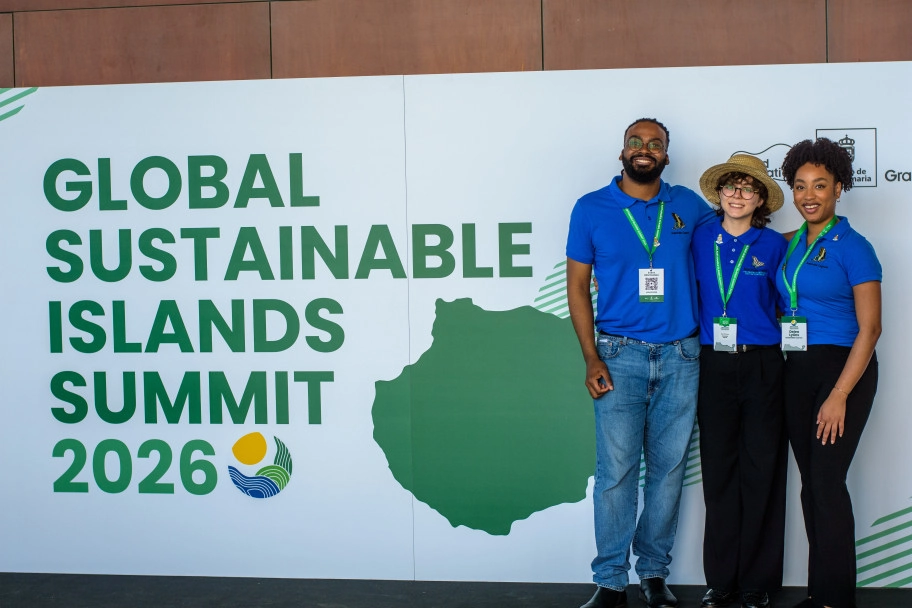
Sustainable Cayman is proud to welcome back its delegation from the Global Sustainable Islands Summit (GSIS) 2026 in Gran Canaria, Spain, marking its second participation and building on momentum from GSIS 2025 in St Kitts.
The summit convened leaders, policymakers, practitioners, and innovators from Small Island Developing States (SIDS) and Overseas Territories (OTs) to address urgent challenges in climate resilience, sustainable development, and island-led innovation.
Sustainable Cayman delegates Dejea Lyons, Rickeem Lashley, Soleil Parkinson, and Matthew Feitelberg participated in high-level sessions, site visits, and cross-regional exchanges, strengthening connections with island communities facing similar environmental and economic pressures.
Island-to-Island Learning
The summit highlighted the value of knowledge exchange between islands facing shared constraints. Delegates emphasised that locally grounded approaches are often more practical and resilient, particularly where reliance on imported materials, external expertise, or fragile supply chains can undermine long-term sustainability.
A key theme was strengthening island-to-island partnerships and advancing implementation-focused collaboration, where shared learning translates into practical, scalable action.
Field Visit Highlight: Coastal Restoration in Practice
A field visit to the Las Dunas de Maspalomas restoration project demonstrated how native vegetation can stabilise dunes and support natural coastal processes—approaches relevant to erosion and shoreline challenges in the Cayman Islands. Rickeem Lashley, Sustainability Ambassador and PhD student at the University of Essex, reflected:
“One of the standout moments for me was visiting the Las Dunas de Maspalomas restoration project in Gran Canaria, where we saw how native plants are being strategically grown and planted to stabilise dunes and support natural coastal processes. It was particularly valuable because many of the challenges they are addressing closely mirror the erosion, beach loss, and restoration issues we face in the Cayman Islands.”
Matthew Feitelberg, Sustainable Design Consultant, who will be starting a PhD at University of Cambridge in the fall, highlighted broader implications:
“This project raised important questions about how similar approaches could be applied to Seven Mile Beach. In many contexts, ecological and financial sustainability are closely linked. More fundamentally, restoration means little without systemic change—development models, land use, ecology, construction methods, and geomorphology are all interconnected. Restoration without reform is simply the maintenance of decline.”
The visit reinforced the importance of context-specific, island-based solutions that reduce dependence on external inputs and supply chains.
Capacity, Political Will & Financing Innovation
GSIS 2026 underscored that key barriers to sustainability are often institutional rather than financial, with capacity constraints and political will remaining persistent challenges.
The summit’s emphasis on implementation was echoed across sessions, including a panel contribution noting that “we have a governance crisis, not a conservation crisis,” highlighting the central role of institutions in enabling delivery.
Dejea Lyons, Sustainable Cayman Executive Committee Member and Master of Science student at University College London, reflected on this imperative:
“A clear message from GSIS 2026 is that the challenge is no longer a lack of targets or ambition—it is delivery. Islands are already demonstrating what works, but accelerating implementation will require aligning policy, finance, and capacity to move from commitments to measurable outcomes on the ground.”
From Innovation to Implementation: Climate Finance in Action
A key development was the launch of a Climate Change Trust Fund by the Virgin Islands, an independent mechanism supporting adaptation and mitigation projects. The model offers a potential pathway for more stable, locally governed climate financing in other island jurisdictions.
The summit reinforced that island communities are both on the frontlines of climate change and leading the development of practical, scalable solutions. The focus on implementation, financing innovation, and strengthened partnerships signals momentum toward more actionable, locally driven responses.
Delivering on Climate Resilience at Home
For the Cayman Islands, these insights present opportunities to strengthen capacity, rethink conservation and financing approaches, and deepen collaboration with other island jurisdictions.
Sustainable Cayman will continue integrating lessons from GSIS 2026 into its work on coastal restoration, mangrove protection, and nature-based solutions, including collaboration with the financial sector and Government to explore a sustainable finance framework for the Cayman Islands.
Sustainable Cayman extends its sincere thanks to the Ministry of Health, Environment & Sustainability for its sponsorship and support of the delegation.