

The Cayman Islands Department of Environment (DoE) is proud to announce that three near shore marine areas around the Cayman Islands have been officially recognised as Important Shark and Ray Areas (ISRAs) in the newly released North American and Caribbean Atlantic Regional e-Atlas, published by the IUCN SSC Shark Specialist Group. Cayman’s ISRAs can be viewed via the interactive ISRA e-Atlas.
The International Union for Conservation of Nature (IUCN) consists of governments, scientific experts, and conservation organisations and is recognised as the world’s leading authority on the status of the natural world and conservation measures. IUCN helped conceive, shape or support major global environmental agreements, including CITES, the Convention on Migratory Species (CMS), and the Convention on Biological Diversity (CBD). Within the IUCN, the Species Survival Commission (SSC) Shark Specialist Group is the leading authority on assessing the status of sharks, rays, and chimaeras, planning for conservation, and catalysing conservation actions. In 2022, the IUCN SSC Shark Specialist Group started the Important Shark and Ray Areas (ISRA) project to identify, map, and support the conservation of habitats that are necessary for the survival of sharks, rays, and chimaeras worldwide. ISRA designation does not create new legal protections. It provides an internationally recognised scientific framework that can inform marine spatial planning, conservation measures, policy development, and future research priorities.
The three recognised Cayman Islands ISRAs are:

Figure 1. Map of the Cayman Islands. Designated Important Shark and Ray Areas are highlighted in red.
These areas were identified and approved under Criterion A (Vulnerability) and Sub-criterion C5 (Undefined Aggregations) for the Endangered Caribbean Reef Shark (Carcharhinus perezi). The recognition highlights the global significance of Cayman waters as locations where aggregations of this Endangered species are regularly observed.
The designations were made possible through data collected by the Sharklogger Network, a pioneering citizen science programme led by the Department of Environment.
The Sharklogger Network was launched in 2016 by Dr. Johanna Kohler, supported by Marine Conservation International with funding from the UK Government through Darwin Plus. Resident divers, snorkelers, and local dive operators meaningfully contribute first-hand to DoE Shark Research by logging and submitting their dive/snorkel information year-round. The data collected by the Sharklogger Network is a valuable resource in helping monitor Cayman’s coastal shark population. Since its launch, the programme has generated a comprehensive dataset on the coastal shark populations in the Cayman Islands and continues to provide valuable information for local shark conservation and management.

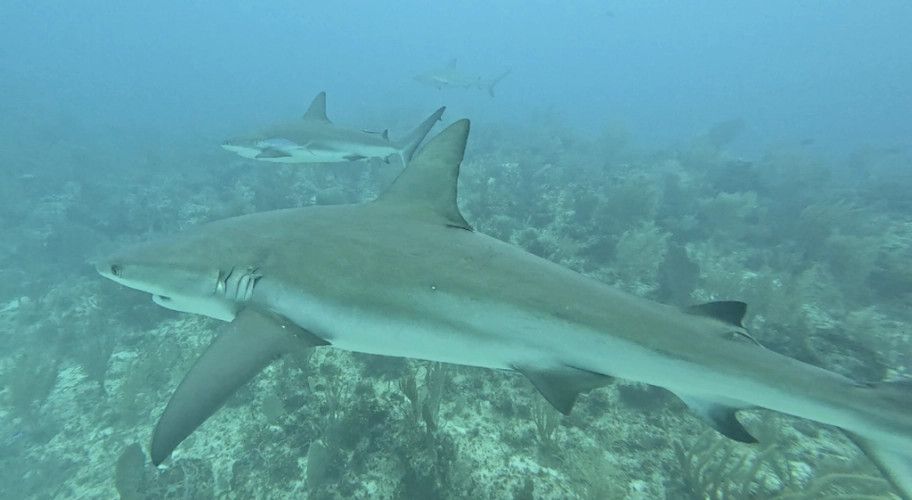
Figure 2. Photo of three Caribbean reef sharks, seen as part of an aggregation of 5 female Caribbean reef sharks at Gun Bay in February 2025. Sizes ranged from 150-198cm, total length (TL). Image courtesy of Anne Veeder.
“It’s incredible to have Cayman’s unique habitat recognised on such a global scale. Ten years ago, this citizen science programme started out in the hope to supplement structured field surveys to help answer questions about our near shore shark populations. Fast forward to today, the Sharklogger Network, thanks to its unwavering support from dedicated volunteer residents and dive operators, has generated a massive long-term database with observational information that are meaningful and can be used for various research and conservation objectives”, expresses Dr Johanna Kohler
Between 2017 and 2025, more than 57,000 recreational dive surveys were submitted by divers across the Cayman Islands. Analysis of these observations demonstrated that the three recognised areas support aggregations of Caribbean reef sharks and meet the internationally recognised criteria for ISRA designation.
“This recognition highlights the extraordinary value of the Cayman Islands’ marine environment and demonstrates the power of long-term monitoring and the role of citizen science in conservation,” explains Anne Veeder, Research Officer who coordinates the Sharklogger Network. “Many local divers and dive operators have contributed directly to DoE Shark Research through The Sharklogger Network, and this achievement reflects the commitment of our dive community over many years.”
The Cayman Islands’ inclusion in the ISRA network places these sites among 191 Important Shark and Ray Areas and 39 Areas of Interest identified throughout the North American and Caribbean Atlantic region, following contributions from 393 participants and experts involved in the regional assessment process.
Each of the three Cayman Islands ISRAs represents a unique habitat where Caribbean reef sharks regularly occur:

Figure 3. Image of 5 Caribbean reef sharks around the Ocean Frontiers coral nursery in Gun Bay. Image courtesy of Megan Ehman, DoE.
Importantly, these sites are among only a small number of locations in the Cayman Islands where consistent shark aggregations have been documented, underscoring their significance for future conservation and research efforts.
The Department of Environment extends its sincere thanks to the divers, snorkelers and local dive operators, including dive professionals, who have contributed and continue to submit dive data to the Sharklogger Network. Gratitude also extends to Asia O. Armstrong (IUCN SSC Shark Specialist Group – ISRA Project) for her assistance with the ISRA nomination and assessment process, as well as DoE staff: Anne Veeder (Research Officer – Shark Research & Conservation Programme), Dr Johanna Kohler (Manager – Shark Research & Conservation Programme), and Jeremy Olynik (DoE Senior Geographical Information Systems Officer) whose collaborative efforts helped secure this important recognition for the Cayman Islands.
The newly designated ISRAs are shown in the regional factsheets which can be found on the DoE website at: https://doe.ky/marine/sharks/iucn-important-shark-ray-areas-in-the-cayman-islands/
The IUCN SCC Shark Specialist Group will revisit this region for reassessment and update of additional ISRAs in 10 years’ time. If you would like your dives to contribute to future ISRAs in the Cayman Islands, join the Sharklogger Network by emailing sharkloggers@gmail.com.
Website: https://doe.ky/marine/sharks/sharklogger-network/
Instagram: @sharkloggernetwork
Facebook: The Sharklogger Network
The Department of Environment Shark Research & Conservation programme is proudly supported by the Cayman Islands Brewery through donations from sales of White Tip Lager.