

As countries around the world observe World Mosquito Day on 20 August, the Mosquito Research and Control Unit (MRCU) is reflecting on the significant transformation of mosquito control in the Cayman Islands and the programme’s continued importance to public health, quality of life and the country’s development.
World Mosquito Day commemorates the discovery made by British doctor Sir Ronald Ross in 1897 that female Anopheles mosquitoes transmit malaria. More than a century later, mosquito-borne diseases remain a significant public health concern across many parts of the world, including the Caribbean and the wider Americas.
For the Cayman Islands, the day is also an opportunity to remember just how different life was before organised mosquito control and the important role MRCU has played in helping shape modern Cayman.
Mosquitoes were once part of everyday life
Mosquito numbers in early Cayman were not simply an inconvenience. They affected almost every aspect of daily life.
Historical records from as early as the 1800s describe mosquito numbers in Cayman as a significant national problem.
Residents carried smoke pans or maintained fires to help protect themselves from mosquitoes. Smoke was also used around livestock, with historical accounts describing animals being overwhelmed by the sheer volume of mosquitoes.
Outdoor activity, particularly around sunset and after dark, was severely restricted. For earlier generations, mosquitoes were an unavoidable part of life.
There was also little debate over whether mosquito control was necessary. The conditions experienced by residents made that need clear.
MRCU was established in 1965 under the leadership of entomologist Dr Marco Giglioli with a mandate to research Cayman’s mosquito problem and develop effective methods of control.
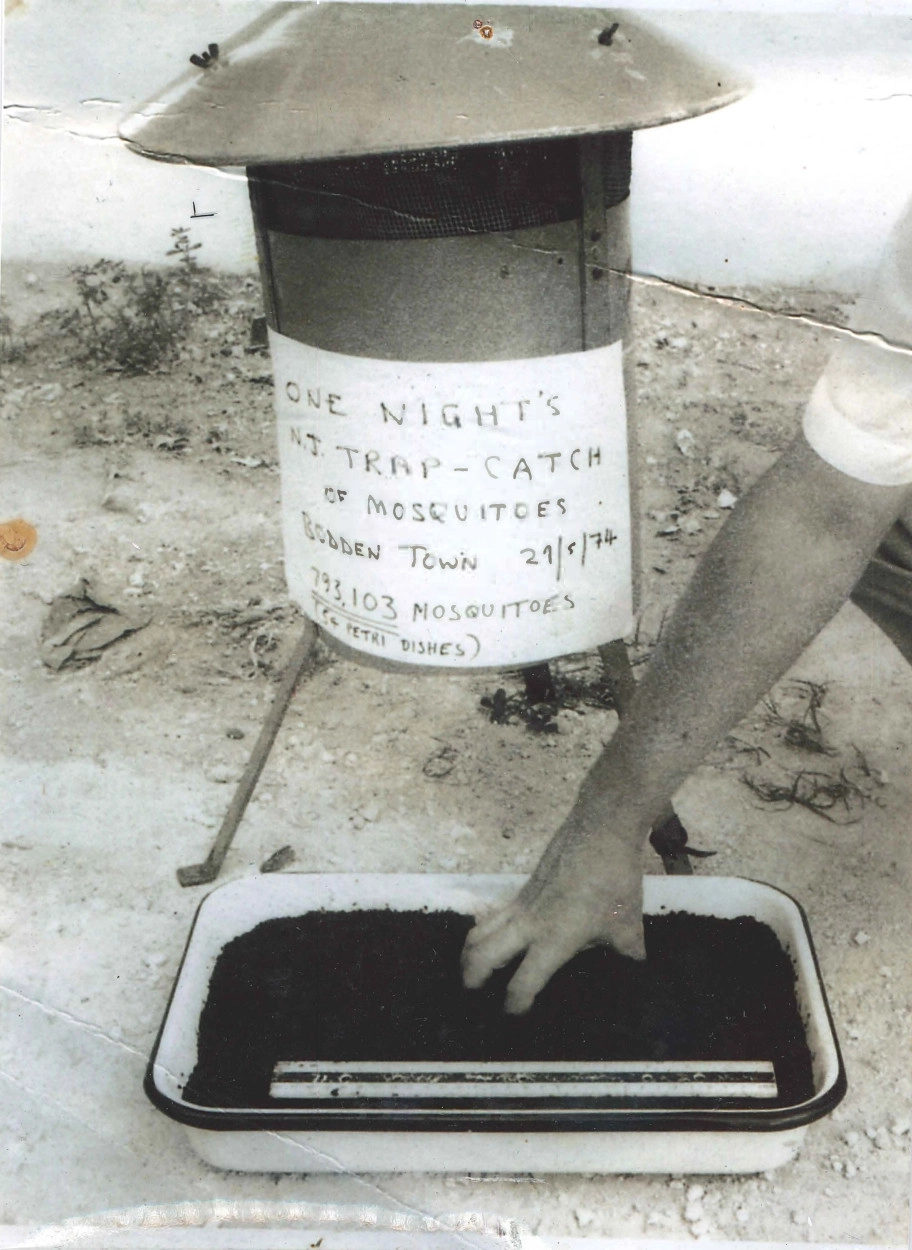
Even after the Unit was established, the scale of the challenge remained extraordinary. In 1974, a single mosquito trap in Bodden Town collected 793,103 mosquitoes in one night.
Over the following decades, Cayman developed a comprehensive mosquito management programme incorporating scientific research, surveillance, wetland management, larviciding, property inspections, aircraft operations, truck fogging, resistance monitoring, disease surveillance and public education.
That work helped fundamentally change everyday life in the Cayman Islands.
The ability to enjoy yards and outdoor spaces, host community and sporting events, support tourism and hospitality, develop communities and conduct business without the mosquito conditions experienced by previous generations has contributed to Cayman’s quality of life and economic development.
Simply put, the Cayman Islands would not be what it is today without sustained mosquito control.
Success has changed expectations
The success of Cayman’s mosquito control programme has also changed how mosquitoes are viewed.
Conditions that were once considered part of everyday life are now understandably considered unacceptable by many residents.
Today, MRCU may receive a request from one resident asking that mosquito control products not be applied near their property, while at the same time receiving requests from neighbours or other people in the surrounding community asking for additional mosquito control because numbers are affecting their ability to enjoy their homes and outdoor spaces.
These competing requests demonstrate the balance MRCU must maintain.
The Unit must consider the needs of the wider community while taking into account public health, environmental conditions, surveillance data, weather, product requirements, insecticide resistance and other operational factors.
MRCU recognises that residents may have different views on mosquito control. Operational decisions, however, must be based on scientific evidence and the needs of the wider community.
Success also does not mean that Cayman will never experience high mosquito numbers.
The Cayman Islands is a tropical environment with extensive wetlands, seasonal rainfall and tidal flooding. There will be seasonal periods when environmental conditions produce large mosquito hatches and numbers increase to levels that are uncomfortable for residents.
During those periods, it can take time for control operations to bring populations back down, particularly when new breeding continues because of rainfall, tides or other environmental conditions.
The presence of uncomfortable mosquito numbers during a seasonal increase does not mean the mosquito control programme has failed.
Rather, Cayman’s long-term success can be seen in how dramatically mosquito populations have been reduced from historical levels, the ability to respond to seasonal increases and, importantly, the country’s record in preventing sustained mosquito-borne disease transmission.
Protecting public health
While nuisance mosquito control has transformed quality of life in Cayman, protecting the public from mosquito-borne disease remains one of MRCU’s most important responsibilities.
The Aedes aegypti mosquito, which is present in the Cayman Islands, is capable of transmitting diseases including dengue, Zika and chikungunya.
These diseases continue to circulate in parts of the Caribbean and wider Americas. Cayman’s high level of international travel means there will always be a risk of an infected traveller returning or arriving while carrying a mosquito-borne virus.
Cayman’s mosquito-borne disease surveillance data demonstrate both this continued vulnerability and the country’s success in preventing mosquito-borne diseases from becoming endemic within the community.
During the past 10 years (2016-2025), Cayman recorded 133 mosquito-borne infections. Of these, 77 were imported and 56 were recorded as locally acquired, meaning no travel history was reported during the incubation period.
The majority of the recorded locally acquired cases occurred during two dengue outbreaks in 2019 and 2023, which accounted for 21 and 24 locally acquired dengue cases respectively.
Outside those dengue outbreaks, the surveillance data also include six Zika cases and two malaria cases over the 10-year period where no travel history was indicated.
The data highlight the continuing risk that mosquito-borne infections can be introduced into Cayman and lead to local transmission. At the same time, these events have remained limited and have not resulted in sustained transmission or any mosquito-borne disease becoming endemic in Cayman. This reflects the importance of maintaining effective surveillance, mosquito control and a rapid public health response.
Surveillance data for 2026 to date show two imported malaria cases and no locally acquired cases of dengue, malaria, chikungunya, Zika or West Nile virus.
For an internationally connected country surrounded by a region where mosquito-borne diseases regularly circulate, preventing sustained transmission is an important public health achievement.
It is also an achievement that requires continuous work.
Success cannot lead to complacency
Cayman’s strong record does not mean the threat has disappeared.
Imported mosquito-borne disease cases will continue to occur as residents and visitors travel between Cayman and countries where these diseases are circulating.
When a suspected or confirmed case is identified, MRCU works with public health partners to respond quickly. Depending on the circumstances, this may include increased mosquito surveillance, property inspections, identification and treatment of breeding sites and targeted mosquito control operations.
Much of this work happens without being visible to the wider public.
An important measure of success is what does not happen. An imported case does not develop into widespread local transmission, a small number of cases does not become a prolonged outbreak, and mosquito-borne disease does not become continuously established within the community.
Maintaining that level of protection supports more than disease prevention. It contributes to healthier and more resilient communities, protects quality of life and supports a country where residents, businesses and visitors can safely enjoy outdoor spaces.
More than nuisance control
MRCU’s work today extends far beyond responding when residents notice mosquitoes.
Surveillance helps identify which mosquito species are present, where populations are increasing and where intervention may be necessary.
Teams work to control mosquitoes during the larval stage before they emerge as adults, inspect residential and commercial properties for disease-vector mosquitoes, monitor insecticide resistance and conduct research to improve future control methods.
Aircraft and truck fogging are additional tools used when adult mosquito populations require control.
No single method can control every mosquito, and no mosquito control programme can eliminate mosquitoes entirely.
The goal is to use an integrated, science-based programme to keep populations at manageable levels, respond effectively when environmental conditions cause increases and minimise the risk of mosquito-borne disease transmission.
Protecting a Cayman success story
World Mosquito Day provides an opportunity to recognise generations of MRCU employees whose work has helped transform the Cayman Islands.
Many people living in Cayman today may never experience the extraordinary mosquito conditions faced by previous generations, and that is precisely the point.
On most days, being able to enjoy an evening outdoors, attend an outdoor event, operate a tourism business, develop communities close to wetlands or simply spend time in a yard without being overwhelmed by mosquitoes is something many people now take for granted. That did not happen by accident.
It is the result of more than six decades of scientific research, surveillance, investment, innovation and mosquito control.
There will continue to be challenging seasons. There will be periods when mosquito numbers become uncomfortable. There will also continue to be differing views about how mosquitoes should be controlled.
What cannot change is the need for Cayman to remain prepared.
Mosquito-borne diseases continue to circulate around the region, environmental conditions continue to change and mosquito populations will continue to respond to rainfall, tides and other natural factors.
MRCU will therefore continue to adapt its programme, strengthen surveillance, evaluate new technologies and respond to both nuisance mosquito populations and public health threats.
Cayman’s history demonstrates what life can be like without effective mosquito control. Its quality of life today demonstrates what sustained investment in mosquito control can achieve.
Residents can support these efforts by regularly checking their yards and properties for containers holding water, emptying and scrubbing them where possible, covering water storage containers and allowing MRCU officers access to inspect and treat potential mosquito breeding sites.