

The summer of 2023 was the hottest on record and brought with it one of the most extensive global coral bleaching events. This event decimated coral reefs around the world and left their future looking more uncertain than ever.
The Central Caribbean Marine Institute (CCMI)’s Healthy Reefs campaign has been monitoring the reefs of Little Cayman since 1998, with our 28th year of coral monitoring efforts to take place this summer. As one of the longest coral reef monitoring data sets in the Caribbean region, this allows CCMI’s researchers to understand trends and changes over time and make informed decisions to protect coral reefs. Results from the 2024 surveys were bleak, revealing the greatest reduction in coral cover in Little Cayman since monitoring began, at 9.8%, down from 26% pre-2023 marine heatwave.
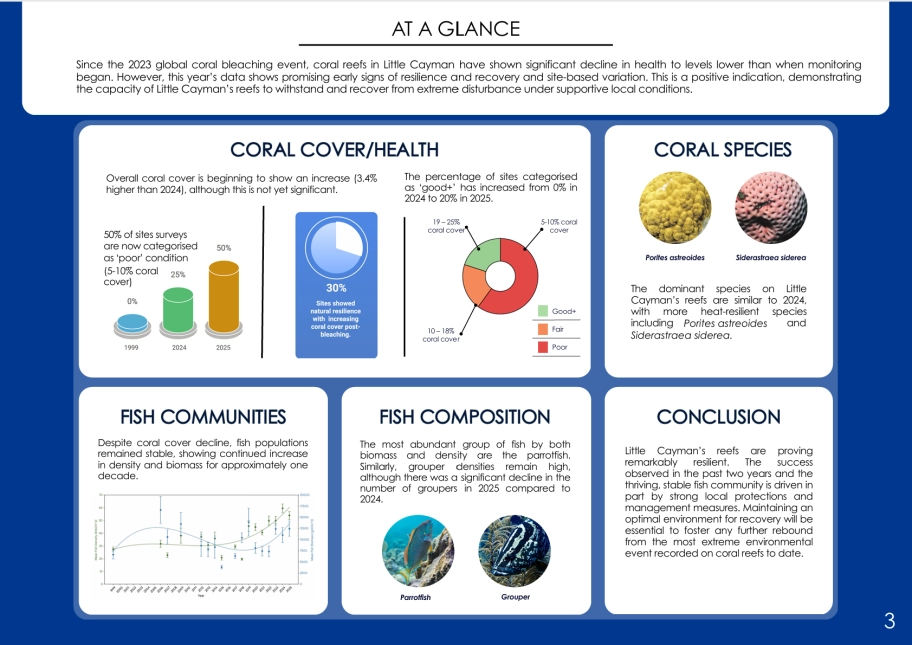
However, data from 2025 surveys, as seen in this year’s Healthy Reefs Report Card shows an early improvement in coral cover, from 9.8% to 13.4%. Although not yet significant, this upwards trend is a positive sign that recovery in Little Cayman is beginning. Interestingly, when analysed at a site-specific level, the picture is a little more complex. Although overall coral cover increased by 3.6%, this varied between sites. Twenty percent of sites surveyed showed a significant increase in coral cover from 2024 to 2025, with an additional site, Coral City, showing high resilience to bleaching, exhibiting no significant loss and maintaining stable coral cover throughout the bleaching period. In total, 30% of sites have either maintained pre-bleaching coral levels or demonstrated significant recovery this year, whereas the other 70% of sites either show minor, non-significant recovery (40%) or no recovery at all (30%).
Coral recovery can rarely be measured over the course of 1-2 years. Corals are slow-growing animals, and it is not uncommon to see no signs of recovery on a reef for at least three years post disturbance, with recovery to pre-bleaching levels often taking a minimum of seven years - and up to nearly 30 years in some circumstances. To this end, an early indication of some signs of recovery is reassuring and a testament to the conditions in Little Cayman, such as protections and minimal local disturbance, that are conducive to recovery and resilient reef systems.
Fish populations, however, have thrived in recent years, showing consistent increases since 2016, and dramatic increase in density and biomass in 2024, which was maintained through 2025. Healthy fish populations are beneficial for overall reef resilience, as herbivores manage levels of macro-algae on reefs, which, if left unchecked, can outcompete corals for space on the reef and hinder coral growth.
Although the overall picture of Little Cayman’s reefs remains mixed, such an early increase in coral cover with some significant recovery at specific sites, partnered with continued thriving fish populations throughout 2024 and 2025, point to a picture of optimism, hope, and ecosystem resilience to unprecedented levels of disturbance.
Little Cayman is a Mission Blue Hope Spot, described as:
‘Small but mighty, the island shines as a flourishing example of what protection for marine ecosystems can look like when conservation is prioritized’.
More so now than ever, in the face of such unpresented pressures, does this statement ring true. The marine ecosystem in Little Cayman is historically highly resilient and has demonstrated successful recovery stories, such as the Nassau grouper spawning aggregation, recovering from as low as 1,000 individuals to almost 9,000 over a 10-year period. And these early signs of coral recovery could echo these stories of rebound.
Research and science-based actions are key at this crucial time to further understand the underlying ecological processes that contribute to reef resilience to inform management and protection. Continued protection, alongside research and active conservation, is critical in conserving this ecosystem.
During the 2023 bleaching event, CCMI’s coral nursery suffered severe mortality, losing nearly 90% of corals. However, genetic research identified three resilient genotypes of staghorn coral that survived the nearly 20 degree-heating weeks. Since 2023, these three genotypes in the nursery have recovered and increased from just 17 fragments to nearly 300 as of March 2026. CCMI’s nursery likely represents one of the last remaining populations of the critically endangered staghorn coral (Acropora cervicornis) in Little Cayman.
There is no denying that the impact of the 2023 bleaching event was severe and that coral cover saw unprecedented decline in Little Cayman and globally. However, recovery of any kind this soon after such disturbance is optimistic, compounded further by sites that showed high resilience and maintained coral cover throughout and those with already significant rates of recovery.
While the future of coral reefs around the world remains uncertain, Hope Spots such as Little Cayman provide a welcome feeling of optimism. These pockets of resilience will play a crucial role in preserving marine biodiversity in the face of climate change. Such sites often serve as a source of larvae for neighbouring reefs, re-seeding less resilient and more damaged reefs, and providing benefits through ocean currents beyond the boundaries of Little Cayman.
The support of CCMI’s sponsors is invaluable. CCMI would like to express deepest gratitude to this year’s Healthy Reefs sponsors, Wheaton Precious Metals International, Foster’s Supermarket, Cayman Water, and Ugland Properties, and the Restoration programme sponsors that have made this work possible: The Ernest Kleinwort Charitable Trust, Artex Cayman Islands, Walkers, and Marfire.
Read the 2025 Healthy Reefs Report Card here: https://tinyurl.com/CCMI-25HRR